
Digital Assistants
Your best people shouldn’t be doing your worst work
Bespoke AI-powered Digital Assistants, built around your processes
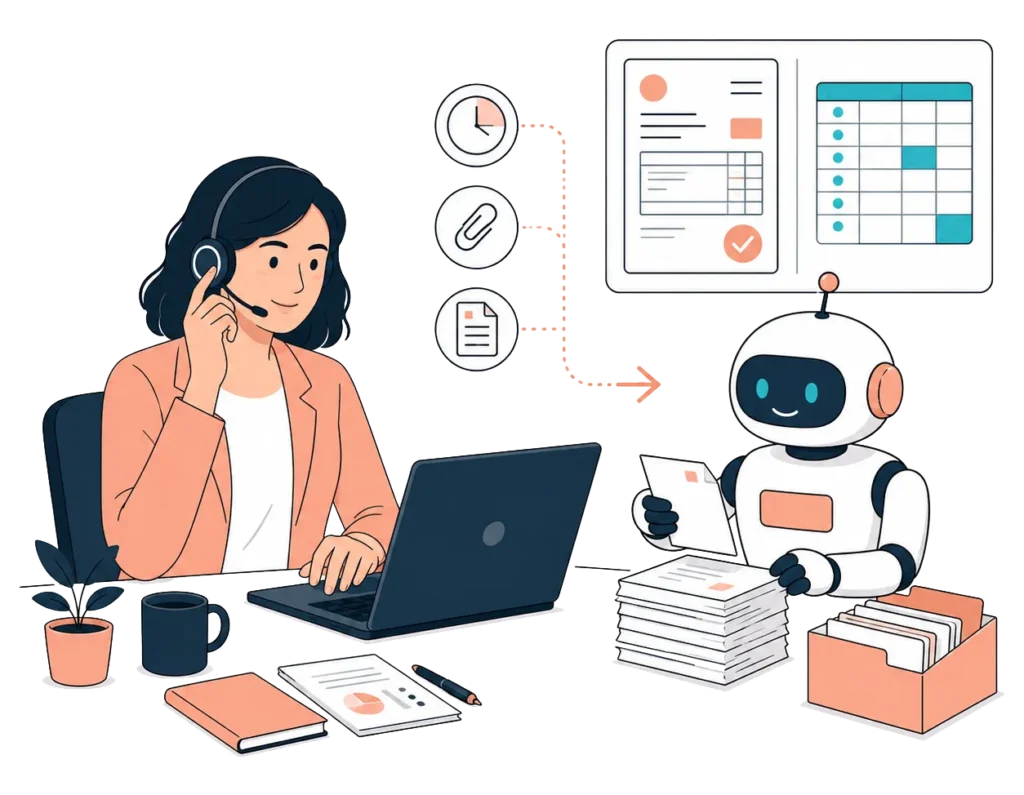
Every hour your team spends on manual data entry, invoice processing or spreadsheet reconciliation is an hour they’re not spending on work that actually strengthens your business.
Supporting franchisees. Solving problems. Improving performance. Building relationships.
A Digital Assistant takes the repetitive workload off their plate without cutting corners and without requiring an in-house technical team to run it.
You understand what you want a process to achieve. The technical work is handled for you.

What it does
Built for the boring, done properly
Most repetitive administration falls into three broad categories:
- Rule-based tasks that need completing consistently
- Documents that need reading, checking and processing
- Routine conversations or actions across different channels
A Digital Assistant is built specifically around your process, not taken from a generic template.
It can read information from screens, emails and documents. It can follow agreed rules. It can enter, transfer, check and reconcile data. It can update systems, trigger actions and produce reporting.
In short, it handles the volume, repetition and parts of the process nobody enjoys.
Human validation remains in the loop wherever it should.
This isn’t about removing people from decisions, it’s about removing people from the parts of their job that do not need their judgement.
How we work
Built around how your business actually works
Every Digital Assistant begins with a process you already have. We map how the work is currently completed, which systems are involved, what rules apply and where exceptions or human approvals are required.
The solution is then designed around that real workflow.
You are not forced to replace software that already works or redesign the business around a new platform. A Digital Assistant can often operate across the applications your team already uses, including accounting software, CRMs, email, spreadsheets, shared folders and compliance systems.
No new hardware, and no need to hire a dev team.

Case study
What this looks like in practice
One growing franchise business expanded from a handful of vehicles to 10 within six months.
The volume of invoicing, reconciliation and compliance administration grew with it.
Its two-person administrative team was spending hours manually cross-referencing job information, creating invoices, matching remittances.
A bespoke Digital Assistant was developed to manage the invoicing and reconciliation process, with immediate results:
- More than 14 hours of admin saved every week
- No immediate need for additional administrative hires
- Automated invoice creation and reconciliation
- Improved consistency across the process
- More time for operational and franchisee support
- Immediate ROI when the process went live
The success of the initial automation later led to the development of a bespoke franchise dashboard, giving the franchisor live visibility of revenue, compliance and network activity.
The Digital Assistant simply removed work that was stopping the team from doing more valuable things.
How it works
From process to working solution
You understand what you want a process to achieve. The technical work is handled for you. The implementation is designed to be practical and collaborative, and typically involves:
- Identifying and recording the process
- Reviewing the systems, rules and exceptions involved
- Defining the proposed solution and scope
- Building and testing the digital assistant
- Completing user acceptance and pressure testing
- Putting the process live with additional early support
- Monitoring performance, savings and opportunities for improvement

Data security
Secure, and built to prove it
Data security is considered throughout the design and delivery of each process. Credentials are managed through secure password-management tools rather than being hard-coded or stored in plain text.
Access can be encrypted, role-based and logged, with human approval included where a system requires it.
Deployments are designed to support applicable privacy and data protection requirements, including GDPR.


Stay in control
Human where it matters
A Digital Assistant is well suited to repetitive, rules-based and high-volume tasks. It’s not a replacement for context, empathy or commercial judgement.
Some processes require validation or authorisation, or an experienced person to decide what happens next.
That’s why human review can be built into the workflow at agreed stages.
Your team remains in control – they simply stop carrying the burden of every manual step.
Frequently asked questions
Digital assistants FAQs
What kind of work can a Digital Assistant handle?
Digital Assistants are best suited to repetitive, clearly defined and rules-based work, such as invoicing, reconciliation, data entry, document processing, updating accounting software or CRMs, compliance checks, reporting and transferring information between different applications.
Processes involving judgement can still be partly automated, with human review built in where required.
Do we need an in-house IT team?
No. A Digital Assistant is delivered as a managed service, with process mapping, development, testing and implementation handled for you. Your team needs to explain and demonstrate how the current process works and confirm that the finished solution performs as expected.
Do we need to replace our existing software?
Usually not. Digital Assistants are designed to work across the applications already used by the business. The discovery process establishes which systems are involved, what access is needed and whether elements such as multi-factor authentication require a specific workflow.
How long will it take to see a return?
That depends on the process, the volume of work and its current cost. The case study business above saved more than 14 hours every week from the day the Digital Assistant went live, while avoiding the immediate need for additional administrative staff.
A clear commercial case should be established before development begins.
Is our data secure?
We operate an ISO/IEC 27001-certified information security management system and use secure credential-management practices. Access can be encrypted, controlled and logged, with human validation incorporated where needed.
Each deployment should also reflect the client’s systems, policies and applicable data protection requirements.
Does a Digital Assistant replace our team?
No. Its purpose is to remove repetitive manual work so people can concentrate on tasks requiring relationships, judgement, problem-solving and direct support. For growing businesses, it may also reduce or delay the need to recruit additional staff purely to manage increasing administrative volume.
How is a Digital Assistant different from ordinary software integration?
A standard integration usually connects specific systems in a fixed way. A Digital Assistant can often work across several applications and complete a sequence of actions much as a person would, including reading information, applying rules and updating different systems. The exact solution depends on the process being automated.
How does implementation work?
The existing process is recorded and mapped before the solution is scoped. The Digital Assistant is then developed, tested and reviewed through user acceptance before going live. An initial period of additional support allows the process to be monitored and refined once it begins operating in the live environment.

Find out more
See what it could take off your plate
Growth doesn’t have to mean more admin and more pressure on the people already holding the business together.
If repetitive work is absorbing the time of people you need elsewhere, it may be time to redesign the process.
Let’s see what a Digital Assistant could take off your plate.